
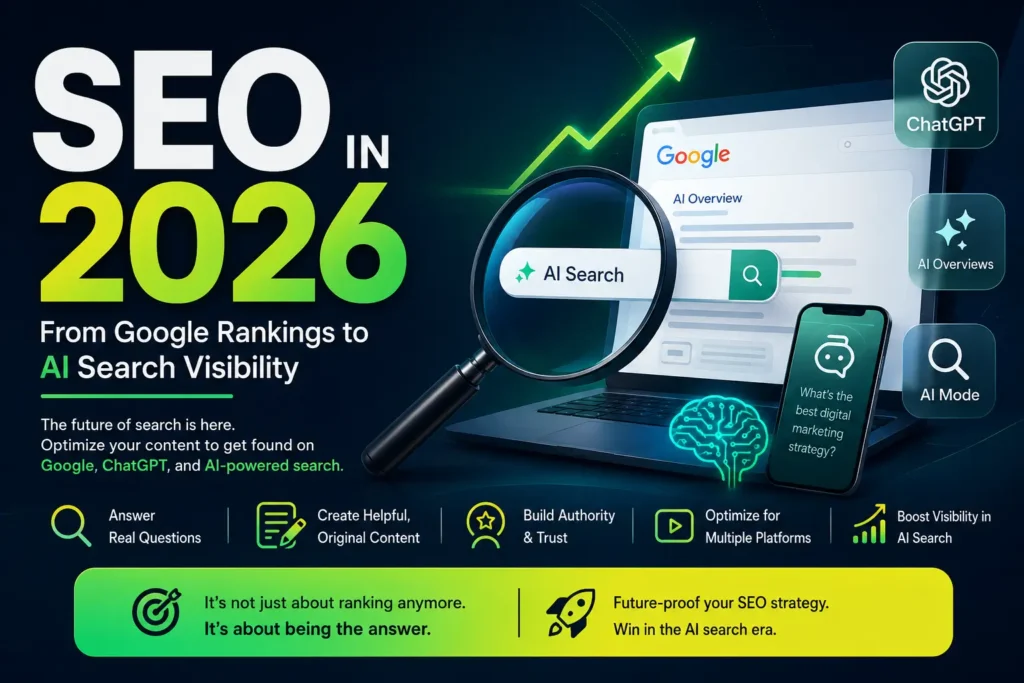
For years, getting discovered online meant one thing: ranking on Google.
Businesses researched keywords, optimized webpages, built backlinks, published blogs, and waited for organic traffic.
But search is no longer just a list of ten blue links.
In 2026, people are increasingly discovering information through Google AI Overviews, AI Mode, ChatGPT, social platforms, video platforms, marketplaces, and other AI-powered experiences.
That means the question businesses should be asking is no longer:
“How do I rank #1 on Google?”
The better question is:
“How do I make my brand the answer wherever people search?”
This is the biggest shift happening in SEO in 2026.
Google itself has published new guidance for optimizing websites for its generative AI search features, while emphasizing that traditional SEO fundamentals remain important.
What Is SEO in 2026?
SEO in 2026 is evolving from simply optimizing webpages for keywords into optimizing an entire digital presence for people, search engines, AI systems, and discovery platforms.
Traditional SEO focused heavily on:
- Keywords
- Backlinks
- Meta titles
- Meta descriptions
- Technical SEO
- Search rankings
Modern SEO still needs these fundamentals, but successful brands are going further.
They are also focusing on:
- Helpful, original content
- First-hand experience
- Structured information
- Author credibility
- Visual content
- Video
- Local content
- Brand mentions
- Social search
- AI search visibility
- Entity understanding
Google’s current guidance specifically stresses unique, non-commodity content and says SEO best practices continue to matter for generative AI features in Search.
Why AI Search Is Changing Everything
Imagine someone wants to buy a new smartphone.
Previously, they might search:
“Best smartphone under ₹30,000.”
Google would return pages of results.
Now they may ask an AI assistant:
“I’m a gamer who wants excellent battery life, a good camera and strong performance. Which phone should I buy under ₹30,000?”
That’s a completely different search experience.
The user isn’t simply looking for webpages.
They want an answer.
This is why AI search is changing how businesses approach content.
Google says consumer behaviour is moving toward more conversational and exploratory search experiences, with AI helping people investigate topics in greater depth.
SEO vs AEO vs GEO: What’s the Difference?
Three terms are increasingly appearing in digital marketing discussions:
SEO — Search Engine Optimization
Optimizing your website so search engines can understand and rank your content.
AEO — Answer Engine Optimization
Optimizing content so it can directly answer questions in search and answer-based experiences.
GEO — Generative Engine Optimization
Optimizing your digital presence so AI-powered systems can understand, reference, and potentially recommend your brand or content.
However, don’t make the mistake of thinking GEO replaces SEO.
It doesn’t.
Google’s own guidance says SEO best practices remain relevant to visibility in its generative AI search experiences.
Think of it like this:
SEO → Be discoverable
AEO → Be the answer
GEO → Be understood and referenced by AI
Brand → Be remembered
The strongest strategy combines all four.
7 Ways to Improve Your AI Search Visibility in 2026
1. Create Content That Actually Helps People
AI can generate thousands of generic articles in seconds.
That means generic content has less competitive value.
If your article simply repeats information already available across hundreds of websites, why should Google—or an AI system—prefer it?
Instead, provide something genuinely useful.
For example, don’t write:
“10 Benefits of Digital Marketing.”
Create:
“How a Small Indian Business Can Generate Its First 100 Leads Online: A Practical 30-Day Plan.”
The second article provides a specific problem, audience and outcome.
2. Demonstrate First-Hand Experience
This is one of the biggest opportunities for websites in the AI era.
Don’t just tell readers what something is.
Show them what you’ve learned.
Include:
- Examples
- Case studies
- Screenshots
- Original research
- Comparisons
- Personal observations
- Real-world data
- Experiments
- Expert opinions
AI can summarize existing knowledge.
Experience is much harder to replicate.
3. Answer Questions Clearly
AI systems need information that can be understood easily.
Structure your articles around real questions.
For example:
What is AI SEO?
How does AI search affect Google rankings?
Does SEO still work in 2026?
How can a small business appear in AI search?
What is GEO?
Is traditional SEO dead?
This structure also makes your content easier for humans to scan.
4. Optimize for Search Intent—not Just Keywords
Keyword stuffing is not a strategy.
Suppose your target keyword is:
“best digital marketing agency in India.”
You shouldn’t repeat that phrase 30 times.
Instead, understand what the searcher actually wants.
They may be looking for:
- Pricing
- Services
- Reviews
- Portfolio
- Case studies
- Location
- Industry expertise
- Contact information
Create content that satisfies the entire search journey.
5. Don’t Ignore Social Search
Search is no longer limited to Google.
People increasingly use social platforms to discover:
- Products
- Restaurants
- Tutorials
- Businesses
- Reviews
- Creators
- Trends
- Services
Recent 2026 marketing research highlights the shift toward interest-based discovery and social search, alongside the continued importance of short-form video and community-building.
That means your SEO strategy should connect your:
Website + Instagram + YouTube + LinkedIn + Google Business Profile + other relevant platforms
into one digital ecosystem.
6. Build a Recognizable Brand
Here’s something many SEO strategies overlook.
Imagine two websites publish equally good articles.
One belongs to an unknown website.
The other belongs to a recognized industry brand with:
- Consistent content
- Expert authors
- Social presence
- Reviews
- Media mentions
- Strong topical coverage
The second brand has a much stronger overall digital footprint.
In an AI-driven search environment, brand authority becomes increasingly important.
Don’t only build pages.
Build recognition.
7. Create Content in Multiple Formats
A single blog post shouldn’t have to do all the work.
Turn one strong topic into:
Blog → YouTube video → Instagram Reel → LinkedIn post → Carousel → Infographic → Newsletter
This creates multiple opportunities for discovery.
Google’s guidance for generative AI search also highlights the value of providing useful local, shopping, image and video content where relevant.
Is Traditional SEO Dead?
No.
But traditional SEO is evolving.
Technical SEO still matters.
Keywords still matter.
Internal links still matter.
Page experience still matters.
Structured data still matters.
High-quality backlinks still matter.
But these are no longer enough by themselves.
The winning strategy in 2026 is:
Technical SEO
Helpful Content
First-Hand Experience
Brand Authority
AI Search Optimization
Social Discovery
Multimedia Content
That’s the new SEO ecosystem.
The Biggest SEO Mistake Businesses Can Make in 2026
Trying to game AI instead of creating something genuinely useful.
Some marketers are obsessing over things like:
- AI detection
- Keyword density
- Prompt tricks
- Content volume
- Mass AI-generated articles
- “Secret” GEO hacks
But the fundamentals remain surprisingly simple.
Create something worth finding.
Then make it easy for search engines, AI systems and people to understand.
The Future of SEO Is Not Search Engines vs AI
It’s both.
People will continue using traditional search.
They’ll also use AI assistants.
They’ll search on social media.
They’ll watch videos.
They’ll ask communities.
They’ll use marketplaces.
They’ll discover brands through recommendations.
India is already showing this fragmented discovery behaviour across search engines, AI assistants, maps, marketplaces and other platforms.
So the future isn’t:
Google OR AI
It’s:
Google + AI + Social + Video + Communities + Brand
Final Thoughts
The biggest change in SEO in 2026 isn’t that Google disappeared.
It’s that search itself is becoming more intelligent, conversational and fragmented.
The brands that succeed won’t simply publish hundreds of articles.
They’ll build useful information ecosystems.
They’ll answer real questions.
They’ll demonstrate experience.
They’ll create original research.
They’ll build recognizable brands.
And they’ll make their information easy for both humans and AI systems to understand.
So if you’re working on SEO today, don’t ask:
“How can I rank this page?”
Ask:
“How can I become the best possible answer?”
That’s the mindset that will separate the websites that merely survive the AI-search era from the ones that win it.